Introduction
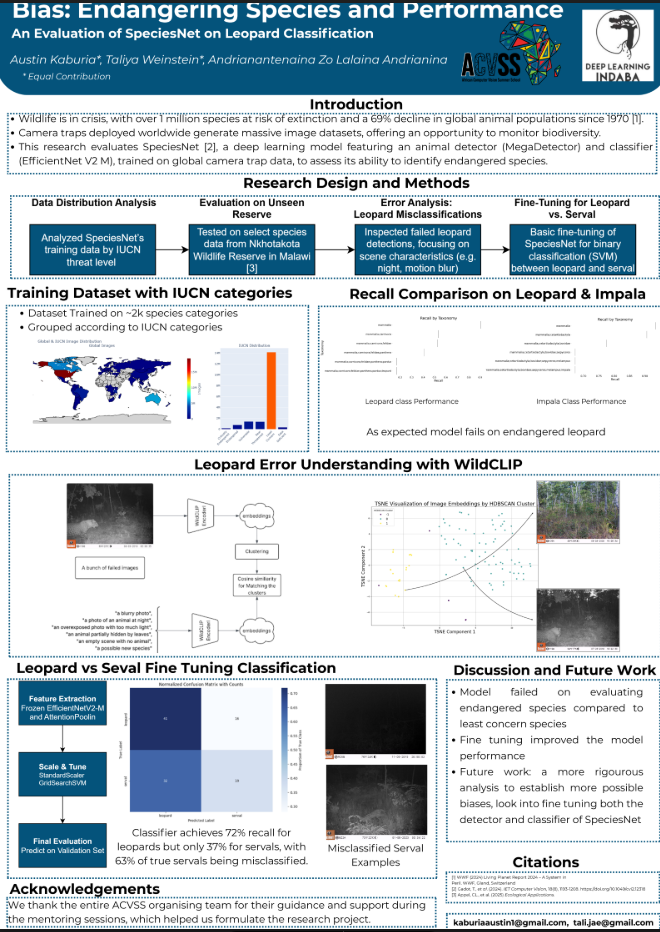
Wildlife is in crisis, with over 1 million species at risk of extinction and a 69% decline in global animal populations since 1970. Camera traps deployed worldwide generate massive image datasets, offering an opportunity to monitor biodiversity. This research evaluates SpeciesNet, a deep learning model featuring an animal detector (MegaDetector) and classifier (EfficientNet V2 M), trained on global camera trap data, to assess its ability to identify endangered species.
Research Design and Methods
- Evaluation on Unseen Reserve: Tested on select species data from Nkhotakota Wildlife Reserve in Malawi.
- Data Distribution Analysis: Analyzed SpeciesNet's training data by IUCN threat level.
- Error Analysis (Leopard Misclassifications): Inspected failed leopard detections, focusing on scene characteristics (e.g., night, motion blur).
- Fine-Tuning: Performed basic fine-tuning of SpeciesNet for binary classification (SVM) between leopard and serval.
Results & Analysis
Recall Comparison
The model struggled with the endangered leopard class compared to common species like Impala.
Error Understanding with WildCLIP
Used WildCLIP embeddings to cluster and understand errors. Common issues included blurry photos, night scenes, overexposed images, and animals partially hidden by leaves.
Leopard vs. Serval Fine-Tuning
The classifier achieved 72% recall for leopards but only 37% for servals, with 63% of true servals being misclassified.
Discussion and Future Work
The model failed to accurately evaluate endangered species compared to least-concern species. While fine-tuning improved performance, future work requires a more rigorous analysis to establish possible biases and explore fine-tuning both the detector and classifier of SpeciesNet.
Acknowledgements
We thank the entire ACVSS organising team for their guidance and support during the mentoring sessions.
Citations
- WWF (2024) Living Planet Report 2024 - System in Peril.
- Gadot, T, et al. (2024). IET Computer Vision, 18(8), 1193-1208.
- Appel, CL, et al. (2025) Ecological Applications.